The Fieldlab Hydrogen in Agri is a practice-oriented testing and collaboration environment in which agricultural entrepreneurs, technology companies, and knowledge institutions work together on the development and demonstration of green hydrogen applications. The project aims to accelerate the sustainability transition of the agricultural sector and to make the role of hydrogen more tangible.
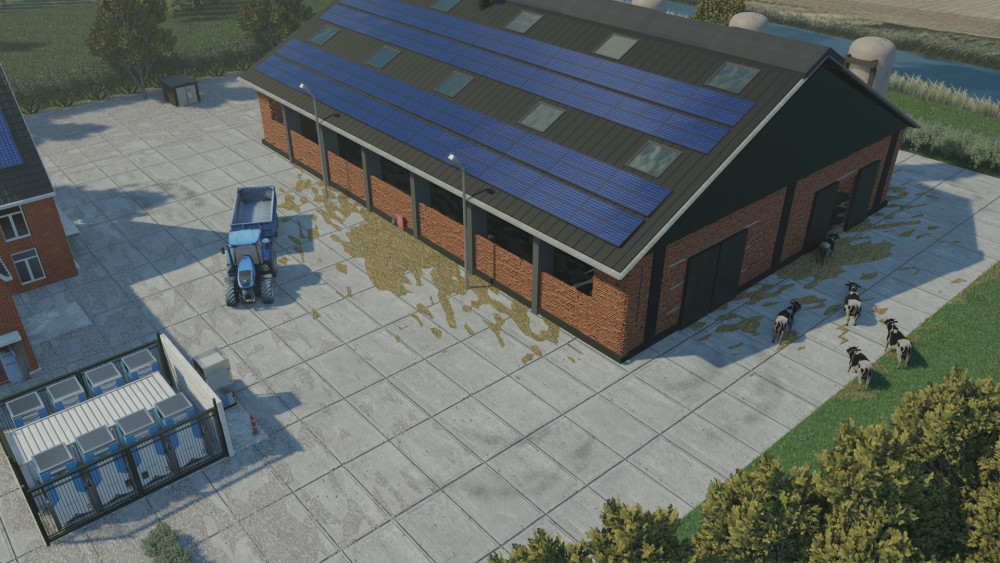
Within the fieldlab, the entire value chain is central: from local hydrogen production based on solar and wind energy to storage, distribution, and on-farm applications. This includes hydrogen-powered machinery and off-grid energy systems for sectors such as greenhouse horticulture.
In addition to technological innovation, the fieldlab explicitly addresses practical challenges faced by farmers, such as grid congestion, permitting, financing, insurance, and the development of viable business cases.
Why hydrogen in agriculture?
Many agricultural businesses aim to generate their own renewable energy, for example through solar panels, but face limitations when feeding electricity back into the grid. Hydrogen offers a solution by enabling local energy storage and flexible use when needed.
By better aligning supply and demand and converting energy surpluses into hydrogen, a robust and future-proof energy system can be created at the farm level.
In addition, hydrogen enables the decarbonisation of mobile and off-grid applications on farms. Agricultural machinery such as tractors, telehandlers, wheel loaders, and excavators often require high power, long operating hours, and fast refuelling — conditions where battery-electric solutions can be limiting. Hydrogen-powered alternatives offer a promising solution, combining zero-emission operation with operational flexibility.
Hydrogen can also be used in so-called H2-Powergens: mobile power units that generate electricity from hydrogen. These systems can provide reliable, off-grid power for applications such as irrigation, peak demand on farms, or greenhouse operations. This makes hydrogen not only a storage medium, but also a versatile energy carrier for both stationary and mobile use in agriculture.
HYGRO’s contribution
HYGRO is a partner in the pilot focusing on local hydrogen production, storage, and supply. As a supplier of green hydrogen with an integrated approach to both production and distribution, HYGRO brings a system perspective, connecting on-farm applications to a broader regional hydrogen network.
Within the project, HYGRO conducts energy and feasibility studies for agricultural businesses. These analyses map production and consumption profiles and translate them into concrete solutions. Feasibility is substantiated through energy studies, basic designs, and business cases.
An important innovation introduced by HYGRO is the use of interchangeable high-pressure buffer containers. These combine three functions in one: storage, buffering, and transport. This approach enables the realization of small-scale, flexible hydrogen infrastructure on farms without the need for large, fixed installations.
Funding and collaboration
The Fieldlab Hydrogen in Agri is a public-private partnership in which solutions are developed not for, but together with entrepreneurs. By combining knowledge, practical experience, and technology, a realistic and scalable approach to hydrogen in agriculture is created.
The project is co-funded by the European Union through the ERDF (European Regional Development Fund) programme Kansen voor West III. This support enables partners to test innovations in practice, build knowledge, and take concrete steps toward a future-proof hydrogen economy. At the same time, the fieldlab contributes to positioning the region as a key hydrogen hub in Northwest Europe.